Appendix A
Body Positions
Straight, piked, tucked and straddled: when one shape becomes another, and how to tell a Manna from a V-sit.
Unofficial summary. The FIG Code of Points and its newsletters are the authority; every rule links to its page there.
E-Jury · from the E-score
The Four Shapes
An element performed with perfection is performed in the specified shape. The shape must be so distinct that the intent is never in doubt.
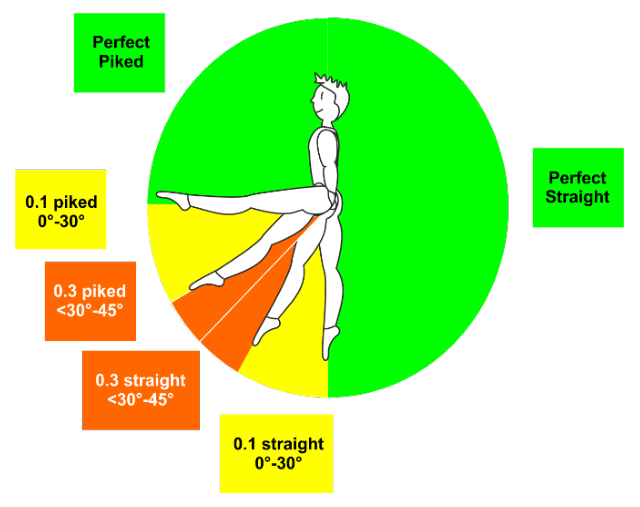
- Straight: shoulders, hips and ankles in one line, or slightly bent in a dynamic element. Hip flexion over 45° at any point makes it pikedHip > 45° → piked
- Piked: knees straight, hips bent at least 90°. Knee flexion over 45° at any point makes it tuckedKnee > 45° → tucked
- Tucked: hips and knees each bent at least 90°, knees brought to the chestHip and knee ≥ 90°
- Straddled: the widest separation the element allowsMaximum split
- Straight with the hips bent up to 30°, or piked up to 30° short of 90°−0.1
- Straight with the hips bent over 30° to 45°, or piked over 30° to 45° short of 90°−0.3
A straight element with 90° of knee bend is a straight element with a large error. The D-Jury does not recognise it.
A handstand is perfectly aligned, with no arch. A strength hold has the arms, the body or the legs perfectly horizontal, as the element requires.
Exceptions are possible where the correct technique of an element needs a different shape.
E-Jury · from the E-score
Non-Distinct Positions
A few elements have similar elements that differ only by position. The gymnast must show which one he means, so there is no doubt.
The Code's examples:
- a bent-arm or straight-arm press
- the amplitude of a floor scale
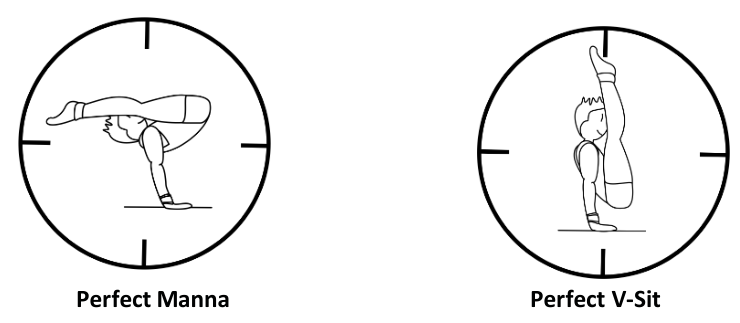
- a V-sit or a Manna
- a planche or a swallow on rings
- Tuck, pike or straight not distinct−0.1or−0.3
- Intermediate position between two elementsAlways deducted, no size given · May be NR
E-Jury · from the E-score
Manna and V-Sit
A perfect Manna has the legs horizontal. A perfect V-sit has them vertical.
Newsletter 1 gives this among its floor items, and the Manna is a floor element. It does not say whether the V-sit scale also applies on rings.
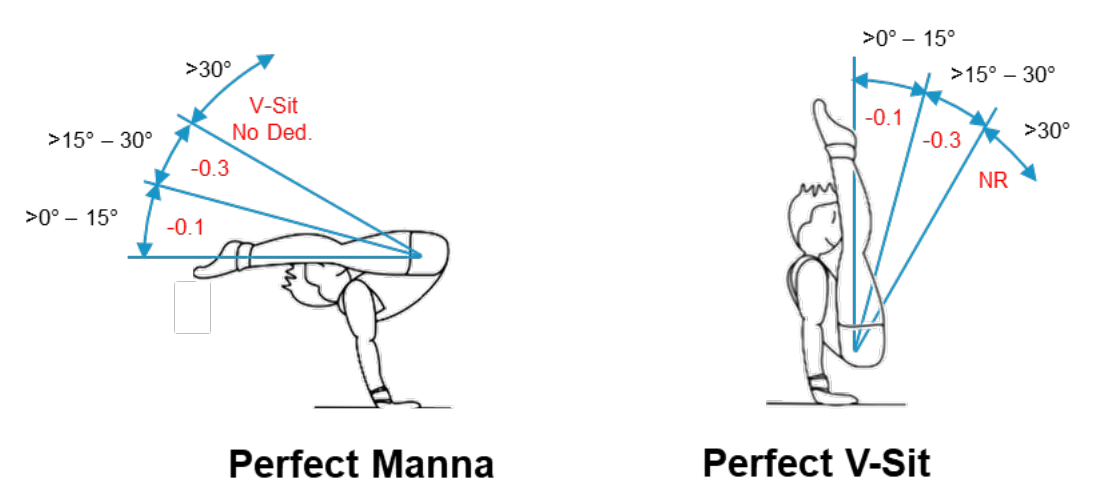
- Manna, legs up to 15° short of horizontal−0.1
- Manna, legs over 15° to 30° short of horizontal−0.3
- Legs more than 30° short of horizontal, up to verticalA V-sit, no deduction
- V-sit, legs up to 15° short of vertical−0.1
- V-sit, over 15° to 30° short−0.3
- V-sit, over 30° shortNR
Newsletter 1, p. 4 · in force from August 2025
Newsletter 1 set the angles. The Code had only the two drawings and the rule that the intended position must be unmistakable.
D-Jury
Double Salto Forward Piked
For full value, the knees stay straight (up to 45° of bend) until the back is horizontal to the ground in the second salto. The Judge Support System has the detailed specification.

- Knees bent up to 45° until that pointFull value
- Knees bent more than 45° before that pointNot full value
The newsletter gives these examples: 20° and 44° pass, 47° fails. It does not say what value the element gets if it fails.
Newsletter 3, p. 2 · in force from 1 January 2026
A measurable test for the piked double front. The newsletter names no apparatus.