Section 9 · Technical Directives
Angles
The Code's angle scales for bending, handstands, holds, legs and twists. Each has its own deductions.
Unofficial summary. The FIG Code of Points and its newsletters are the authority; every rule links to its page there.
E-Jury · from the E-score
Bent Arms, Legs or Body
- Slight bending — up to 45°−0.1
- Strong bending — over 45° to 90°−0.3
- Extreme bending — over 90°−0.5NR
Some exceptions have deductions of their own:
- Parallel bars
- Legs bent before horizontal in the swing of a Moy or any giant, and after Bhavsar-type elements.
- Horizontal bar
- Legs bent during swings, and arms bent at the regrasp after flight elements.
E-Jury · from the E-score
Swings to or Through Handstand
- Swing elements are often expected to go through the handstand, not to an exact handstand, so that the rhythm is not broken. So up to 15° off has no deduction.
- The same scale applies to pommel horse circles that are off perfect cross or side support. There it is deducted every time it happens.
- Up to 15°None
- Over 15° to 30°−0.1
- Over 30° to 45°−0.3
- Over 45°−0.5NR
On pommel horse, the D-Jury does not recognise the element only if it is more than 45° off for the greater part of the element. Horizontal bar has an additional rule of its own.
E-Jury · from the E-score
Holds off Their Perfect Position
This scale is for strength holds and simple holds. It measures the body, arms or legs off the perfect hold position. On rings, the same scale applies when the shoulders or body rise above the hold position in a swing to a hold or a press.
On floor, the Manna and the V-sit have their own scale, from Newsletter 1. It is on the Body Positions page.
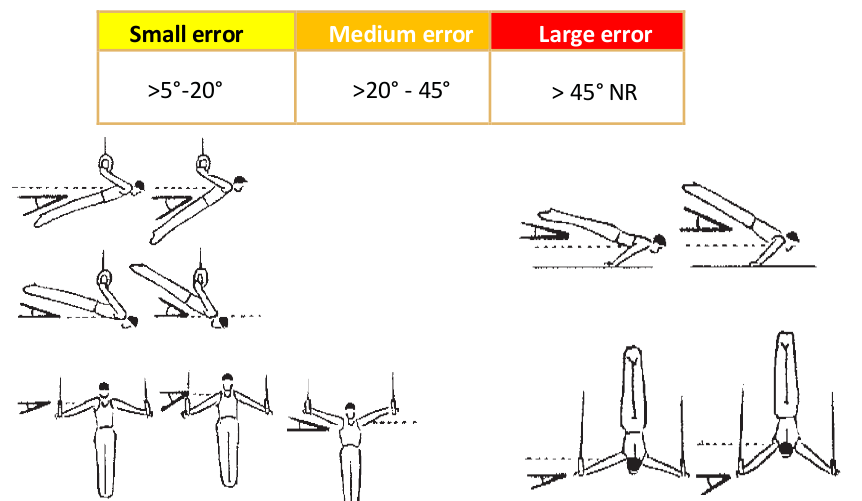
- Up to 5°None
- Over 5° to 20°−0.1
- Over 20° to 45°−0.3
- Over 45°−0.5NR
E-Jury · from the E-score
Bent Arms in Holds and Presses
In holds and strength presses, the arms stay straight throughout. Where it matters, the body also stays straight. This scale is stricter than the scale for other bending.
- Up to 15°−0.1
- Over 15° to 30°−0.3
- Over 30° to 45°−0.5
- Over 45°−0.5NR
E-Jury · from the E-score
Lowering of the Legs
This scale is for lowering the legs during any element to handstand, and in hold parts.
- Up to 15°−0.1
- Over 15° to 30°−0.3
- Over 30° to 45°−0.5
- Over 45°−0.5NR
E-Jury · from the E-score
Incomplete Twists
- Up to 30° short−0.1
- Over 30° to 60° short−0.3
- Over 60° to 90° short−0.5
- Over 90° short−0.5NR
If the twist is more than 90° short, the D-Jury may recognise the element as the lower-valued element with the twist that was completed.