Section 12 · Rings
Rings: Strength and Holds
Two-second holds, rising above the hold, bent arms, presses, the swallow and support scale, and slow rolls.
Unofficial summary. The FIG Code of Points and its newsletters are the authority; every rule links to its page there.
D-Jury
Holds
- Every hold lasts at least 2 seconds.
- A hold is reached when the whole body is static, shoulders and feet included.
- All V holds are shown with the legs vertical.
- No stop shownNRNo difficulty, no Element Group
- Body, arm or leg position more than 45° off the correct hold — a cross with a shoulder angle over 45°, a support scale with a hip bend over 45°NR
The E-Jury's deductions for hold time and hold angle are the same as on every apparatus. See Holds and Presses, and Angles.
E-Jury · from the E-score
Rising Above the Hold
- Limit
- In a swing to a hold or a strength press, the shoulders or body may not rise more than 5° above the perfect hold.
- Measured
- From the bottom of the rings to the middle of the shoulder.
- Deducted
- Separately from the angle of the final hold.
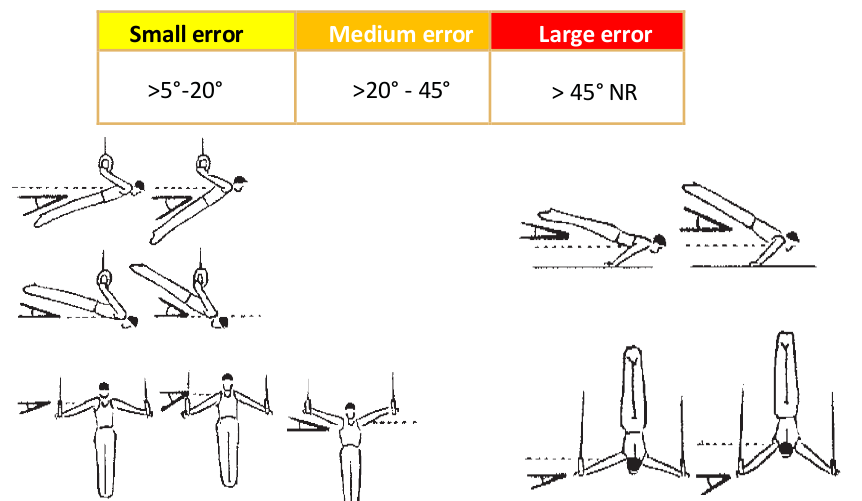
- More than 5°, up to 20°−0.1
- More than 20°, up to 45°−0.3
- More than 45°−0.5NRThe final hold can still be recognised, if it meets the technical requirements
Uprise backward to cross at 25°, lowered to the hold at 10°: 0.3 + 0.1.
The Code's examples:
- Cross press above 45° to swallow: 0.5, and a D for the swallow if it meets its criteria.
- Salto forward to cross entering above 45°: 0.5, and a C for the cross if it meets its criteria.
Code 12.2.1, p. 60 · Code 12.2.3, p. 61 · Code 9.2.14, p. 20
E-Jury · from the E-score
Lowering the Legs
- Swing to handstand or to a hold: legs lowered more than 45° from the entry position−0.5NR
Smaller angles are deducted as on every apparatus. See Angles.
E-Jury · from the E-score
Bent Arms
A strength press from hang is slow, with straight arms and a straight body. It starts from a hang with the arms and body vertical. If not, it is deducted, or classed as swing to strength.
- Bent arms in a swing to a strength hold, or to establish the hold−0.1or−0.3
- Swing to strength with the arms bent more than 90°−0.5NRThe final hold can still be recognised, if it meets the technical requirements
- Bent arms in a hold, or in a press to a strength hold, up to 45°−0.1or−0.3or−0.5
- Bent arms in a hold, or in a press to a strength hold, more than 45°−0.5NR
- Press from hang with the arms or body bent more than 45°−0.5NR
The size follows the angle: up to 15° is 0.1, over 15° to 30° is 0.3, over 30° to 45° is 0.5.
Back uprise to straddle support scale with excessive arm bend: the uprise is not recognised. The straddle support scale can still be given an A.
Code 9.2.8, p. 19 · Code 12.2.3, p. 61 · Code 12.2.3, p. 62 · Code 12.3, p. 62
E-Jury · from the E-score
Presses
A press or lift can follow a hold and end in a 2-second hold. The D-Jury recognises it only if the first hold was recognised and a stop was shown.
A press from one hold to another shows a distinct movement of the body, more than a body width. A press from an imperfect position gets execution deductions.
The Code's examples:
- hanging scale rearways press to swallow
- swallow press to support scale
- Minimal body movement between the two holdsby the D-JuryOnly the final hold is recognised
- Press to strength from a preceding high hold−0.1or−0.3
- Swing with strength−0.1or−0.3
E-Jury · from the E-score
Swallow, Support Scale, Nakayama
Swallow: horizontal, with the body perfectly straight. The middle of the shoulders is level with the bottom of the rings. The arms are wide and clear of the upper body.
Support scale: recognised if the shoulder is completely above the top of the rings. The body should be perfectly straight and horizontal. Slightly wide arms or hands turned out do not change its value.
Nakayama-type elements are performed slowly, through a complete hanging scale rearways. If not, they get execution deductions and may not be recognised.
- Swallow: the arms touching the body−0.1
- Swallow: the arms clearly supporting the body−0.3
E-Jury
Slow Rolls
Slow roll elements, such as the Azarian, are performed with a consistently slow roll and a straight body throughout. Any variation brings E-Jury deductions and may lead to non-recognition.
Newsletter 4 adds a rule for five slow rolls backward: II.52 (Azarian), II.101 (Yan Ming Yong), II.107 slow roll backward to swallow, II.108 (Simonov) and II.120 (Tulloch).
For these five, the roll is slow and controlled, with a straight body and straight arms throughout. Any deviation may bring execution deductions and non-recognition. The body or arms may bend up to the inverted vertical position.
- One of the five: body bent more than 45° once past verticalby the D-JuryNRThe final hold can still be recognised
Newsletter 4, p. 2 · in force from 1 September 2026
For five slow rolls backward: the body or arms may bend up to the inverted vertical. Past it, a body bend over 45° is not recognised, but the final hold can be.
What applied before
For these five too, a consistently slow roll with a straight body throughout. Any variation was deducted and possibly not recognised. It still applies to the other slow rolls.