Section 12 · Rings
Rings: Start, Grip and Composition
The still hang, straight arms and false grip, composition errors, the cables, and Jonasson and Yamawaki.
Unofficial summary. The FIG Code of Points and its newsletters are the authority; every rule links to its page there.
The gymnast
The Exercise
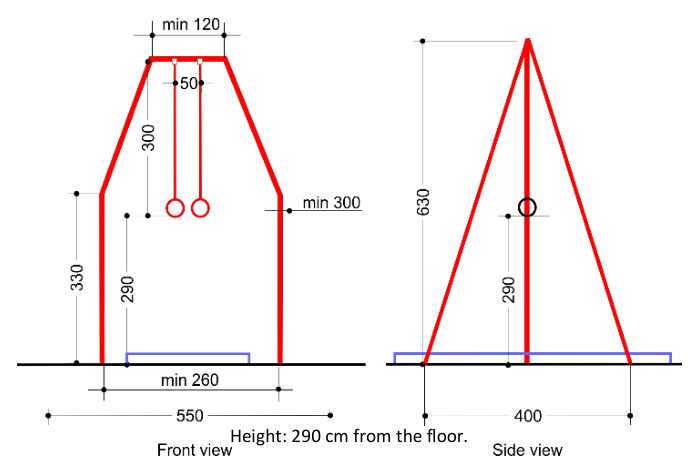
- Height
- 290 cm from the floor.
- Parts
- Swing, strength and hold, in approximately equal portions — in hang, to or through support, and to or through handstand.
- Contemporary
- Transitions between swing and strength, or the reverse. Straight arms should predominate.
E-Jury · from the E-score
The Start
- From a still stand the gymnast jumps, or is assisted, to a still hang with the legs together and good form.
- Evaluation begins the moment his feet leave the floor.
- The coach may not give him an initial swing.
- The exercise starts in a hang with the arms and body vertical and straight.
- The arms do not bend when moving into the first element, unless the element needs it.
- A cast up or an underswing backward may start with bent arms at any time.
- Arms not vertical in the starting hang−0.1
- Legs apart or other poor execution in the jump or lift to the rings−0.3
- Pre-swing before the exercise starts−0.3
- The coach gives the gymnast an initial swing−0.1
Arms not vertical is a small deduction. The first element may also be deducted for strength with swing, because it does not start from a static position.
E-Jury · from the E-score
Straight Arms and False Grip
- The arms are straight where the element allows it. The tables describe the elements that may be performed with bent arms.
- In a transition, the arms bend only when the next element needs it.
- Holds are reached directly, with straight arms and no postural corrections.
A false grip (over grip) is not permitted for strength holds.
- False grip
- The wrists are bent to gain an advantage in a strength element.
- Not a false grip
- Straight wrists, whether the fingers wrap around the ring or not.
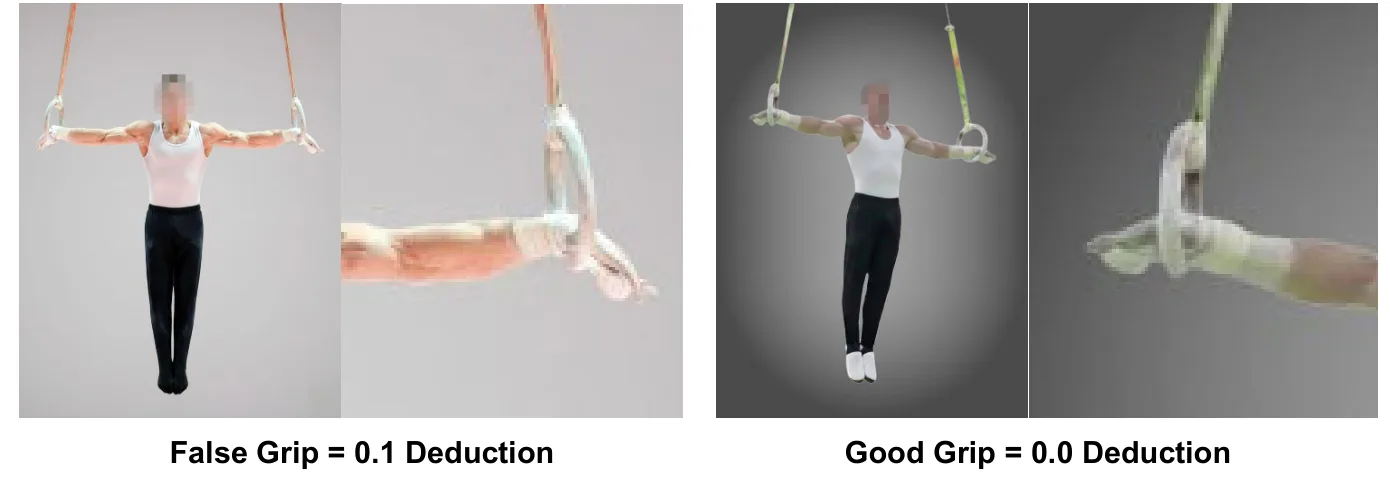
- False grip during a strength hold−0.1each
- Hold with open hands, wrists on top of the rings−0.1each · False grip
- II.25 and II.26 with bent arms: lower arms touching the straps as the technique needsNone
The Code adds that the position of the rings in the hands, with straight wrists and open hands, does not change the evaluation.
Newsletter 3, p. 3 · in force from 1 January 2026
A hold with open hands may be deducted for false grip if the wrists are on top of the rings.
E-Jury · from the E-score
Composition
- Layaway on the back swing — a back swing in support that leads to no value part. It only reverses and swings down in or to a lower hang (kip to support, swing back to layaway, front uprise)−0.3
- Compositional error — Honma to support then lift to L-sit; straddle L-sit to L-sit; Honma to support then lower backward to inverted hang−0.3
- An element crossing the cables, or to the “Li Ning” hanging position−0.3NRComposition error
- Holding a non-listed part for 2 sec or more — inverted pike, dorsal hang, inverted hang−0.1each
Code 12.2.1, p. 60 · Code 12.2.2, p. 61 · Code 12.3, p. 62 · Code 7.6, p. 16
E-Jury · from the E-score
Cables and Straps
- Touching the cables or straps with the arms, feet or another part of the body−0.3
- Supporting or balancing with the feet or legs on the cables−0.5NR
- Excessive swing of the cables, per element−0.1each
Exception: II.25 and II.26 performed with bent arms, where the lower arms touch the straps as the technique needs.
E-Jury · from the E-score
Jonasson and Yamawaki
Jonasson (I.45) and Yamawaki (I.44) type elements — double salto forward to hang — are one continuous movement with the shoulders above ring height.
- Performed slowly−0.1
- With an interruption−0.3
- A clear support phase−0.5NR
With a clear support phase, the element cannot be split into a Honma and a roll forward to hang. If it is slow or interrupted, it is still recognised.
E-Jury · from the E-score
Kips and Handstands
Kip-type elements are swing elements. They go from a deep fold into a clear, dynamic swing. A kip such as III.47 is deducted if it is performed with minimal fold and with strength instead of swing. Article 12.2.3.10 gives no size. The table in 12.3 has “Swing with strength”: 0.1 or 0.3.
- Fall from handstand−0.5NR