Section 15 · Horizontal Bar
Horizontal Bar: Swings and Handstands
The start and the three-swing cast, the bar's own handstand scale, layaways, grip changes, bent legs, and the E-Jury table.
Unofficial summary. The FIG Code of Points and its newsletters are the authority; every rule links to its page there.
E-Jury · from the E-score
The Start
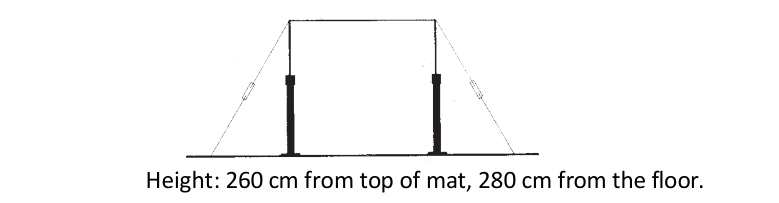
- Height
- 260 cm above the top of the mat, 280 cm above the floor.
- Start
- From a stand with the legs together, or from a short run. He jumps, or is assisted, to a still or swinging hang, with good form.
- Evaluation begins
- The moment he leaves the floor.
A cast of at most three swings has no deduction.
Each of these counts as a swing:
- each movement forward and/or backward
- a jump to a swing
- a coach pushing the gymnast into one
- More than three swings or movements to begin−0.3Total
- Legs apart or other poor execution in the jump or lift to the bar−0.3
- As a mount, uprise backward to support, then a free hip or other movement−0.3
- The same, with no support shown in the swing rearwardNone
Support means an arm angle of less than 45° between arm and body. The uprise to support and back is deducted as a reversal of direction, like a layaway.
Newsletter 1, p. 6 · in force from August 2025
Defines a swing for the three-swing cast: every movement forward and/or backward, a jump to a swing, or a coach's push. Also deducts an uprise backward to support as a reversal of direction when it is the mount.
What applied before
The Code allowed three swings or movements without saying what counted as one.
E-Jury · from the E-score
Swings, Without Stops
The exercise is dynamic:
- made entirely of swinging, turning and flight elements, in fluid connection
- near the bar and far from it, alternating
- in a variety of grips
- with no stops or pauses
- Lack of swing, or a pause in handstand or elsewhere−0.1or−0.3
When a giant swing is modified to prepare a release or a dismount, it is not deducted for missing the handstand. This does not apply if the modification is unnecessary, or so extreme that it violates aesthetic, execution and technical expectations.
Code 15.1, p. 114 · Code 15.2.1, p. 114 · Code 15.3, p. 117 · Code 9.1.4, p. 17
E-Jury · from the E-score
Deviation Through Handstand
Horizontal bar has its own scale for angles past handstand, in two columns. Art. 9.2.13 refers to this scale.
- First column
- The first 15° have no deduction.
- Second column
- The first 30° have no deduction.
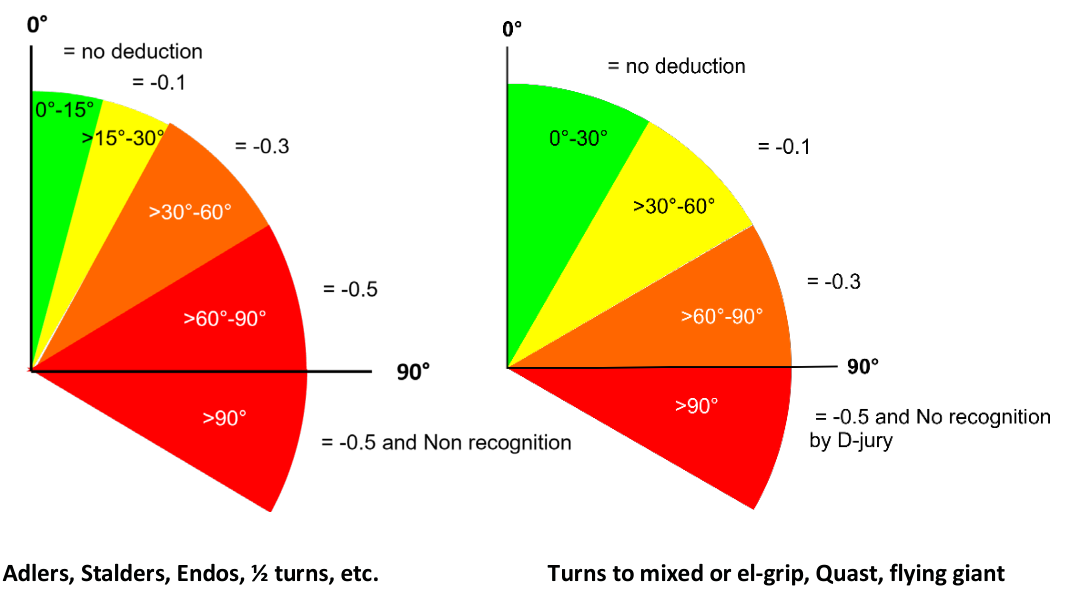
- Adlers, Stalders, Endos, ½ turns and similar: up to 15°None
- Adlers, Stalders, Endos, ½ turns and similar: more than 15°, up to 30°−0.1
- Adlers, Stalders, Endos, ½ turns and similar: more than 30°, up to 60°−0.3
- Adlers, Stalders, Endos, ½ turns and similar: more than 60°, up to 90°−0.5
- Adlers, Stalders, Endos, ½ turns and similar: more than 90°−0.5NR
- Turns to mixed or el-grip, Quast, flying giant: up to 30°None
- Turns to mixed or el-grip, Quast, flying giant: more than 30°, up to 60°−0.1
- Turns to mixed or el-grip, Quast, flying giant: more than 60°, up to 90°−0.3
- Turns to mixed or el-grip, Quast, flying giant: more than 90°−0.5NR
- Endo, Stalder or Weiler: the entry angle deviates from handstand−0.3
Adler elements do not need to be entered from handstand.
Code 15.2.1, p. 114 · Code 15.2.1, p. 115 · Code 15.3, p. 117 · Code 9.2.13, p. 19
E-Jury · from the E-score
Layaways
A layaway is a backward swing to handstand that only reverses direction and swings back down.
The Code's examples:
- after a kip cast or back uprise to handstand: layaway to a giant swing backward, Stalder, free hip or ½ turn to el-grip
- after a back uprise to handstand and a hop to overgrip: swing forward to a giant swing backward, Stalder or free hip
- Layaway on the back swing−0.3each
The angle deductions for missing the handstand are taken as well.
E-Jury · from the E-score
Grip Changes
An additional grip change counts as an additional or intermediate hand support.
- An additional grip change−0.1each
- Zou Li Min to mixed grip, then an immediate grip change−0.1Zou Li Min recognised
- Adler 1/1 turn to mixed grip, then an immediate change to undergrip−0.1
- Endo, kip or uprise backward in overgrip, then two changes in a row to undergrip−0.1For the second
- An element in mixed grip (such as a giant forward, Endo, uprise backward or kip), then one change to undergripNone
Newsletter 1, p. 6 · in force from August 2025
An additional grip change on horizontal bar is deducted as an additional or intermediate hand support.
E-Jury · from the E-score
Bent Legs in Swings
Horizontal bar is one of the exceptions to the general bending scale. Legs bent during swings, and arms bent at the regrasp after a flight element, have their own deductions. None of these is a large deduction.
- Bent knees during swing actions−0.1or−0.3each
- Bent arms on the regrasp after a flight element−0.1or−0.3
E-Jury · from the E-score
E-Jury: Horizontal Bar's Own Deductions
Article 15.3 in full. Horizontal bar has no D-Jury table of its own.
- Legs apart or other poor execution during the jump or lift to the bar−0.3
- Lack of swing, or a pause in handstand or elsewhere−0.1or−0.3
- Low amplitude on flight elements−0.1or−0.3
- Deviation from the plane of movement, up to 15°−0.1
- Deviation from the plane of movement, more than 15°−0.3
- Layaway on the back swing−0.3
- Illegal elements with or from the feet on the bar−0.3
- Bent arms on regrasping after flight elements−0.1or−0.3
- Bent knees during swing actions−0.1or−0.3each
- Elements not continuing in their intended direction−0.3NR
- A flight element with salto over the bar without a giant swing afterwards−0.3
- Entry angle off handstand in Endos, Stalders and Weilers−0.3
- Additional swings at the beginning of the exercise−0.3