Section 14 · Parallel Bars
Parallel Bars: The Exercise
The bars, the mount, back swings that go nowhere, direction after a handstand, and what is not permitted.
Unofficial summary. The FIG Code of Points and its newsletters are the authority; every rule links to its page there.
The gymnast
The Bars
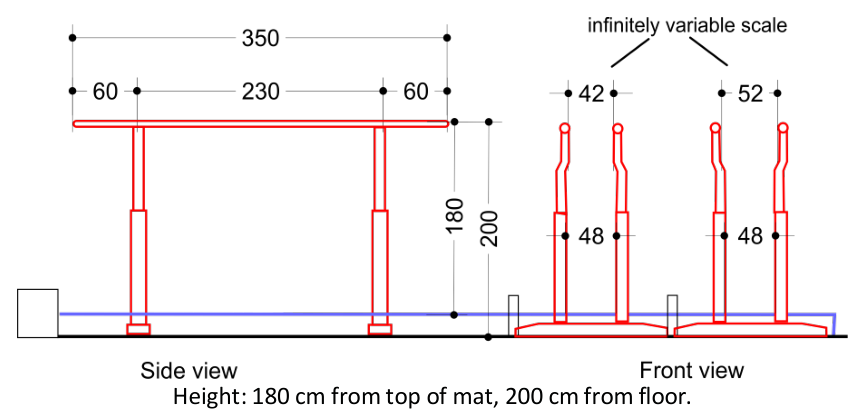
The bars are 180 cm from the top of the mat and 200 cm from the floor. A short run to the mount is allowed only here and on horizontal bar.
E-Jury · from the E-score
The Mount
- Start
- The mount, or the run-up to it, starts from a still stand with the legs together.
- Begins
- The moment the feet leave the ground. They leave it together.
- Not allowed
- Swinging one leg or stepping into the mount.
- Allowed
- A vaulting board at the height of the landing mats.
Pre-elements are not allowed. A pre-element is anything that rotates more than 180° around any axis of the body before the hands grasp the rails.
- One-leg step or swing on the mount−0.3
- Pre-element−0.5
- From stand, jump to L-sit−0.3
- From upper arm, kip to support−0.3
The last two are compositional errors, from Newsletter 3. Newsletter 3 does not say which jury takes them. The E-Jury records compositional errors. Newsletter 3 does not limit the kip from upper arm to the mount.
Newsletter 3, p. 4 · in force from 1 January 2026
Jumping from stand to L-sit, and kipping from upper arm to support, are deducted 0.3 as compositional errors.
Code 14.2.1, p. 93 · Code 14.3, p. 95 · Code 5.4.2, p. 13 · NL3, p. 4
E-Jury · from the E-score
Back Swings That Go Nowhere
A back swing in support or upper arm hang is deducted if it:
- leads to no value part, and
- only reverses and swings down in or to a lower hang or support.
The Code's examples:
- upper arm hang back swing → layaway → glide kip
- support back swing → layaway → front uprise, or hang
- support back swing to handstand (also with 2 sec) → layaway → upper arm hang, hang or support
- glide kip → upper arm hang or momentary support → lay back to upper arm hang
- handstand → lower → shoulder roll forward
- Layaway on the back swing−0.3
E-Jury
Direction After a Swing to Handstand
After a swing to handstand, the next element continues in the same direction. Examples are a ½ turn, a Gatson or a Healy.
- The next element reverses the directionReversal of direction deduction
The Code names the deduction but does not print its size.
D-Jury
Extra Support in Turns on One Arm
No extra support is allowed in elements with turns on one-arm support:
- giant swing with turn
- backward uprise with turn
- forward uprise with full turn
- Felge elements with turn, and similar elements
- An extra support during the turnElement ends where the support occurs
D-Jury
Not Permitted
- A strength or hold element not listed in the difficulty tablesNR
- A salto or dismount from side hang on one barNR
- Junior: a salto with reception in upper arms or bent-arm supportNR
- Junior: any element with a red dot in the tables, including every triple salto dismountNR
Newsletter 3, p. 1 · in force from 1 January 2026
Every triple salto, and so every triple salto dismount, carries a red dot for juniors.