Section 10 · Floor Exercise
Floor: Building the Exercise
The start, every corner and no diagonal three times in a row, pauses, the ending, and the balance or jump requirement.
Unofficial summary. The FIG Code of Points and its newsletters are the authority; every rule links to its page there.
D-Jury
The Start
The gymnast starts from a still stand with the legs together, inside the floor. The exercise and its judging begin with the first movement of the feet.
- The exercise does not begin with an acrobatic tumbling pass−0.3Neutral, from the Final Score
Newsletter 1, p. 3 · in force from August 2025
The first element must be an acrobatic tumbling pass, not a non-acrobatic element.
D1 · from the Final Score
Every Corner, and No Diagonal Three Times in a Row
- A diagonal may be used any number of times, but not more than twice in a row.
- After two, the next pass goes along a side line (under 12 m) to an unused corner.
- The gymnast must go to or from every corner. A last pass towards an unused corner counts for that corner.
- Not to or from every corner−0.3Once
- The same diagonal three times in a row−0.3Once
E-Jury · from the E-score
Pauses and Landings Between Elements
- No pause of two seconds or more before an acrobatic element or series. Arm movements count as pausing, so the two seconds start the moment he comes to a stand.
- Every acrobatic element or series ends in a visibly controlled landing and a stop before anything else follows.
- Pause of 2 sec or more before an element or series−0.1
- Uncontrolled momentary landing, also in a transition−0.1or−0.3or−0.5
Execution errors in a multiple salto are deducted once for the element, not once per salto.
D-Jury
The Ending
- It ends with an acrobatic salto, landed with both feet together.
- It must not be from EG I.
- A multiple salto must be among the eight counting elements. For a senior, it must be the dismount.
- Senior: the dismount is not a multiple salto−0.3Neutral, from the Final Score
- Junior: no multiple salto among the counting elements−0.3Neutral, from the Final Score
- Junior: any triple saltoNR
The Code gives no minimum value. But the lowest multiple salto on floor, the double salto backward tucked, is a C.
Code 10.2.1, p. 26 · Code 10.2.2, p. 26 · Code 10.3, p. 27 · NL3, p. 1
D-Jury
Balance or Jump
The exercise shows either a one-leg balance (I.61 or I.62) or one of the jumps and leaps below. It may be outside the eight counting elements.
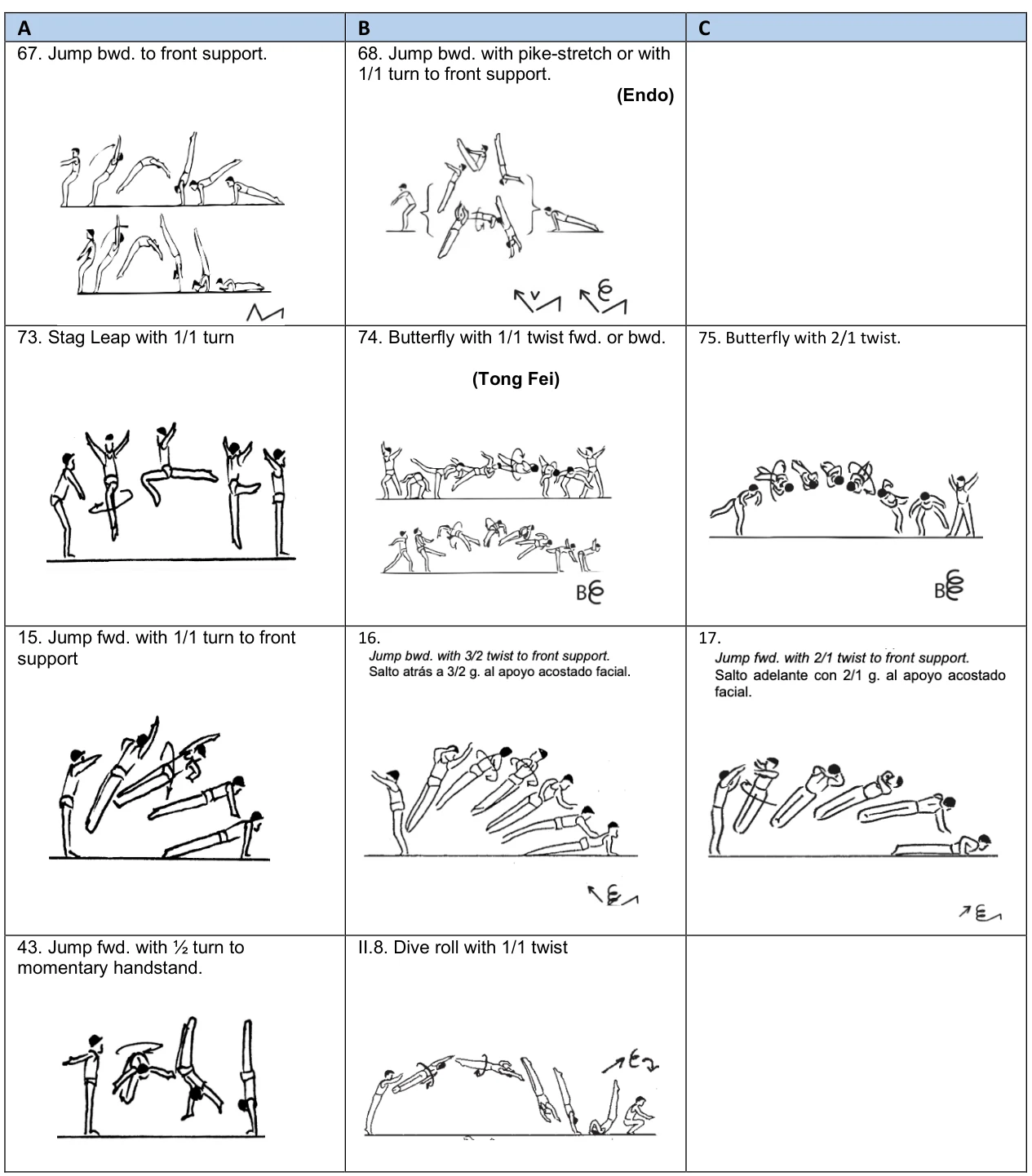
- I.67 — Jump backward to front supportFulfils
- I.68 — Jump backward with pike-stretch or 1/1 turn to front support (Endo)Fulfils
- I.15 — Jump forward with 1/1 turn to front supportFulfils
- I.16 — Jump backward with 3/2 twist to front supportFulfils
- I.17 — Jump forward with 2/1 twist to front supportFulfils
- I.43 — Jump forward with ½ turn to momentary handstandFulfils
- I.74 — Butterfly with 1/1 twist, forward or backward (Tong Fei)Fulfils
- I.75 — Butterfly with 2/1 twistFulfils
- II.8 — Dive roll with 1/1 twistFulfils
- Any stag leap, with or without a turnDoes not fulfil
- Neither a balance nor a listed jump−0.3Neutral, from the Final Score
- A jump to support without a controlled landing on the hands: small or medium errorby the E-Jury−0.1or−0.3
- A jump to support without a controlled landing on the hands: large errorby the E-Jury−0.5NR
The jumps with 1/1, 3/2 and 2/1 turns to front support fulfil the requirement only if the take-off is from two feet. Every jump to support must land on the hands with control, and the Endo must lower to front support with control. If not, the E-Jury deducts 0.1, 0.3 or 0.5, and with 0.5 the D-Jury does not recognise the element.
Newsletter 1, p. 2 · in force from August 2025
A listed jump or leap may replace the one-leg balance.
What applied before
The Code required a one-leg balance, I.61 or I.62.
Newsletter 3, p. 3 · in force from 1 January 2026
No stag leap variation fulfils the requirement any more.
What applied before
Newsletter 1 listed the stag leap with 1/1 turn (I.73). Newsletter 2 accepted it only with the whole turn in the air.
Newsletter 4, p. 2 · in force from 1 September 2026
Jumps with turns to front support fulfil the requirement only from two feet. Every jump to support needs a controlled landing on the hands.
Code 10.2.2, p. 27 · Code 10.3, p. 27 · NL1, p. 2 · NL1, p. 3 · NL2, p. 4 · NL3, p. 3 · NL4, p. 2