Section 11 · Pommel Horse
Pommel Horse: The Exercise
Swing only, cross or side support, scissor amplitude, dismount landings, and the E-Jury's pommel horse table.
Unofficial summary. The FIG Code of Points and its newsletters are the authority; every rule links to its page there.
The gymnast
The Exercise
The gymnast works in support positions on all parts of the horse.
- Typical
- Circular swings with legs apart and together, single leg swings and/or scissors, and swings through handstand with or without turns.
- How
- With swing, and without the slightest interruption.
- Not permitted
- Strength and hold elements.
- Height
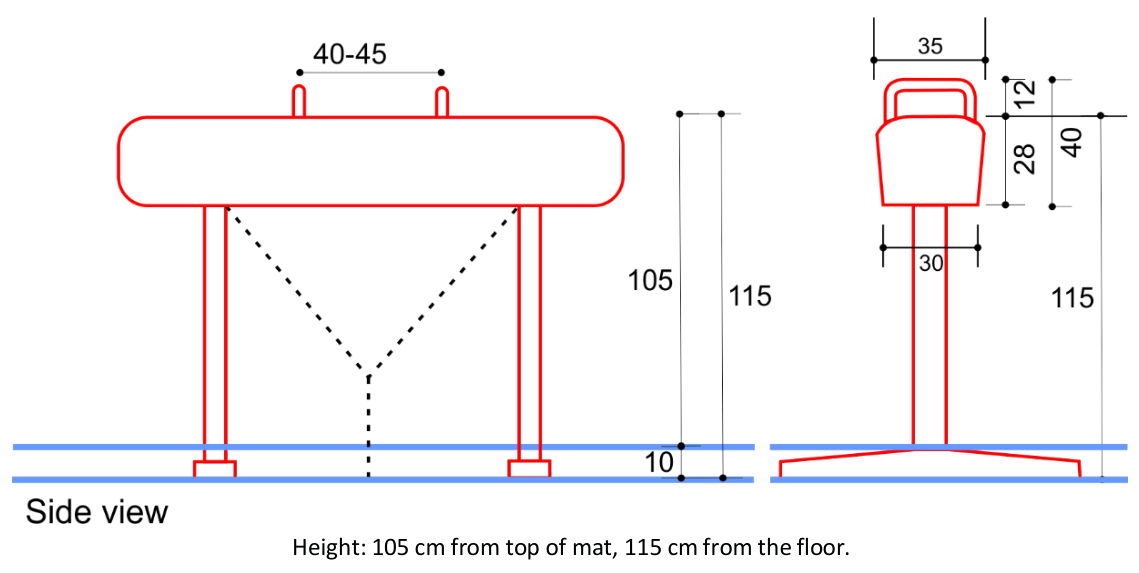
- 105 cm from the top of the mat, 115 cm from the floor.
- Start
- From a stand. An approach step or hop is permitted.
- Judging begins
- The moment his feet leave the floor.
E-Jury · from the E-score
Circles, Flairs and Wendeswings
- Only swings, with no visible pause or strength.
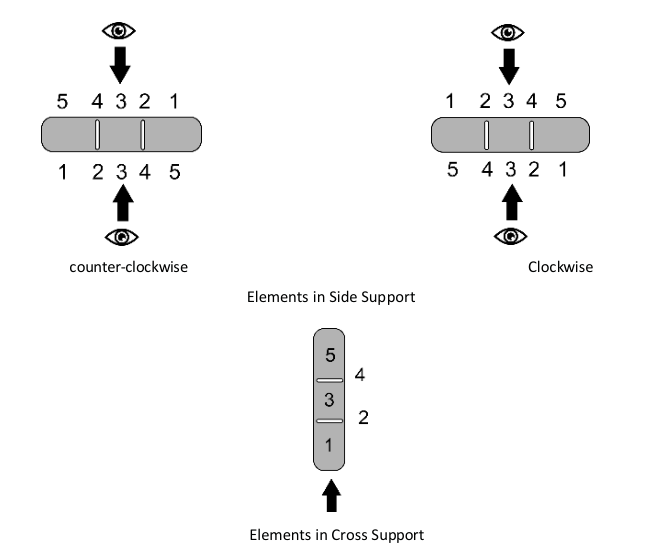
- Circles and flairs only in cross or side support, never oblique.
- Every turning element begins and ends in cross or side support.
- Circles and flairs ideally show complete extension.
- Lack of body extension in a circle or flair−0.1each
- Hip break during circles or flairs−0.1or−0.3each
- Legs apart in a wendeswing−0.1or−0.3or−0.5Each full turn
- Lack of extension is an individual deduction for each element.
- Hip breaks are separate technical errors on each circle or flair.
- Legs apart in wendeswings are an execution error under 9.4, sized as for legs apart during elements: 0°–30°, over 30°–60°, over 60°–90°.
E-Jury · from the E-score
Scissors and Single Leg Swings
Each scissor or single leg swing shows significant elevation and a large separation of the legs. This is judged before, during and after the element.
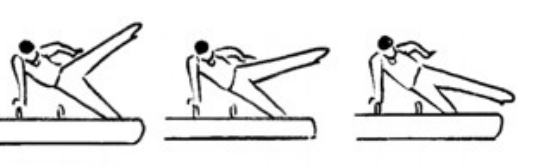
- Legs above the shoulder lineNone
- Between the shoulder line and horizontal−0.1
- Below horizontal−0.3
E-Jury · from the E-score
Dismount Landings
- Crossing dismounts
- A simple handstand dismount, and one with at least 270° turn from side support. They must cross the body of the horse. They should land in cross stand, facing along the long axis of the horse, next to the last hand support.
- Dismounts that are not handstand dismounts
- Show the body at least 30° above the shoulder horizontal before landing.
- Handstand dismount that does not cross the horse, or does not land along the long axis next to the last hand support — atypical, turning problems−0.3
- Landing obliquely, more than 45° off the long axis−0.1
- Landing 90° off the long axis−0.3
- Non-handstand dismount with the body under 30° above the shoulder horizontal−0.3
E-Jury · from the E-score
E-Jury: Pommel Horse's Own Deductions
- Lack of amplitude in scissors and single leg swings−0.1or−0.3
- Handstand with visible strength−0.1or−0.3
- Handstand with visible strength, large−0.5NR
- Pausing or stopping in handstand−0.1or−0.3
- Pausing or stopping in handstand, large−0.5NR
- Hip breaks during circles or flairs−0.1or−0.3each
- Lack of body extension in circles or flairs−0.1each
- Legs apart during elements: 0°–30°−0.1
- Legs apart: over 30°–60°−0.3
- Legs apart: over 60°–90°−0.5
- Cross or side support circles and travels off by over 15°–30°−0.1each
- Off by over 30°–45°−0.3each
- Off by more than 45°−0.5NReach
- Landing obliquely or not facing the long axis: over 45°−0.1
- Landing 90° off the long axis−0.3
- Non-handstand dismount, body under 30° over the shoulder horizontal−0.3
- Scissor to handstand with hip bend−0.1or−0.3
- Scissor to handstand with hip bend, large−0.5NR
- Scissor to handstand without closing the legs, up to shoulder width−0.1
- Scissor to handstand without closing the legs, wider than the shoulders−0.3
- Extra ½ swing on the mount without a leg changing sides−0.3
- Unsteadiness in the handstand dismount, turning problems−0.1or−0.3
- Lowering of legs on elements to handstand, from the original position: 0–15°−0.1
- Lowering of legs: over 15°–30°−0.3
- Lowering of legs: over 30°–45°−0.5
- Lowering of legs: more than 45°−0.5NR
The D-Jury does not recognise a circle or travel only if it is more than 45° off for the greater part of the element. The E-Jury deducts each time.
Section 11 has no D-Jury table and no neutral deduction of its own. The general ones still apply.